
you're probably already winning
Why "being the best" doesn't always translate to being successful

When you hear the word “success,” what’s the first thought that comes to mind?
Money?
Fame?
Yachts?
Having your own Wikipedia page?
If you pictured most of these, that worries me because it means that our shared idea of “success” isn’t individualized despite being defined as “the achievement of the results wanted or hoped for” (Cambridge Dictionary).
This leaves success — a word often used to mean a well-lived life — up to mostly celebrity yacht owners like Gabe Newell. Which means the rest of us aren’t “living well” because few of us will ever achieve more than a small impact. And in that kind of society — our society — it becomes easy to dismiss teachers, police officers, and anyone who didn’t touch millions. So, in a way, yes.
But… how does that make them “unsuccessful?” I know how to count numbers, I know I’m safe because of the police, and I know the local restaurant that makes good seafood. So why does nobody imagine an officer when you picture “success?”
This is why I think more people should reclaim the term. Introducing more meanings can help them know what it is they want with their lives.
I took to redefining “success” for this exact reason. To me, it always meant “having notoriety,” so I was always was the type of person to ask everyone at the end of the year — even people I didn’t know — to sign my yearbook. I also dreamed of entering rooms and seeing people freeze up in awe.
This desire to become notable grew in 9th grade. I spent a year around people who could joke about having three back-to-back tests and a project due the same day. Who discussed their next year APs and electives for fun. If I asked someone if a class might be too difficult — especially if they were jumping in without prerequisites — the response was always “it’s never that bad.” In their smiles, I saw the quiet confidence of people who knew they could balance straight A’s, sports, volunteering, and even start nonprofits.
The main habit I picked up from these friends was the idea of being good at everything. This meant taking every leadership position, being first chair, scoring the highest on the English midterm, and even shooting for a 100 on Tuesday’s vocab quiz “just because.”
All of their optimization for colleges had me asking what I was doing to get successful; I decided that — over the summer — I would practice more Spanish, start a podcast, and improve my Choir voice. Every night, I dreamed of walking in on August 25th with a bunch of cool shit to flex. Yeah, I got an A on the Math test. Also, did you see the podcast I started? Even when summer began, I wanted to be back in school with everything finished.
Soon, however, my distance from friends and school instilled a different impatience.
After it dawned on me that there were only two classes at my school that would serve my future political aspirations, all the desire to beat others at graphing quadratics, annotating books, and balancing chemical equations evacuated my soul. It was all just a distraction from singing and learning languages for fun, things I actually wanted to be the best at.
This brings me to Broken Expectations.
It initially began as a place to dump all my podcast transcripts; since each took about three grueling hours to write and edit, I was keen on saving all of my work. However, once I saw I could make money and grow an audience (in my eyes, be “successful”), it became a real blog.
This brought back that question of what I was doing to be successful. Did I have something someone could point at and say “yeah, that’s why people know him.” Why stop at one thing when everyone around me could pursue multiple goals without breaking a sweat? But if I didn’t really care about school anymore, was I “less successful” for not trying to win in it anyway?
I decided to seek out Drake and Taylor Swift for answers. A common thread I saw in their success stories was an unshakable focus on making the best music they could. In my case, that looked like just podcasting: no Spanish, Choir, or blogging. But while this was the simplest answer to my question, a part of me didn’t want to give up on any of my goals. So I only decided to incorporate obsessive focus into my four pursuits.
Every day, I spent two hours practicing Spanish, an hour doing vocal training and sight reading, three hours writing articles, and evening time either contacting potential guests or making shorts for the podcast. Sometimes, obsession felt good. On those days, you get a sense of purposefulness from knowing you’re on the chase. I’d feel like a man with a plan. Other days, I was doubtful, uncertain, and bored, which is why I leaned on my conviction that I’d be successful so much.
But that was the problem.
My conviction was only certain because it was inherited from society, not built by me; this left me infinitely more vulnerable to doubts. So I made the mistake of asking ChatGPT to affirm this belief — one I wasn’t even sure was mine — that yes, I do want to be successful, I am obsessed, I am willing to give up everything, and I will work hard!
I used this spell to make sleep easier on the nights I procrastinated, if there was even still time to sleep. Closing out whatever tab I was on to then see sunrise made “work without stop” a no-brainer. Not only would I stop feeling like shit but I might accidentally become successful just with all the hours I put in.
But my mind wouldn’t rest until it had actual conviction — not just shame-laced fuel to beat procrastination — that I wanted to lose years, friends, and spontaneity to become successful.
One day, I noticed that whenever I wondered if I might still enjoy singing scales for fun instead of just “to be the best bass,” I always tried to silence the thought. It seemed logical that since I liked singing, the only thing separating me from being the best at it was watching less TV.
Then I thought of Spanish… I wasn’t learning it to “beat others” (although I was a bit jealous of the IB Language students) but because I love recalling the conjugation of an obscure word when I’m practicing with myself, rewatching old Spanish podcasts to see how far I’ve come, or showing off to my sister who’s also trying to learn it. That felt like success to me.
So I decided to look at Choir from this lens; nowhere in the concerts, friendships, rehearsals, or classes did I find competition. It only became another hobby to flaunt when I turned wanting to be an excellent singer into a way to beat my friends at something.
This was my first major reclaiming of how I defined success; it could mean study, community, and fun. But I also felt resistant because this left the rest of my activities (and my life) in jeopardy.
What if I die forgotten because I never became successful?
What if it’s all a waste if I don’t have a massive impact?
I need to be remembered by someone…
Attention and impact were still the cornerstone of how I imagined a successful life, so I took time off from pursuing them. I wrote, sang, and edited shorts like there was no upload or any concert. I stopped the “chase” and watched movies, walked for longer, and ate with my siblings. But my itch to be great at something remained.
It became clear that doing something excellently — or being impactful — was my other definition for success, so I sat down to note how this would look with both the blog and my future.
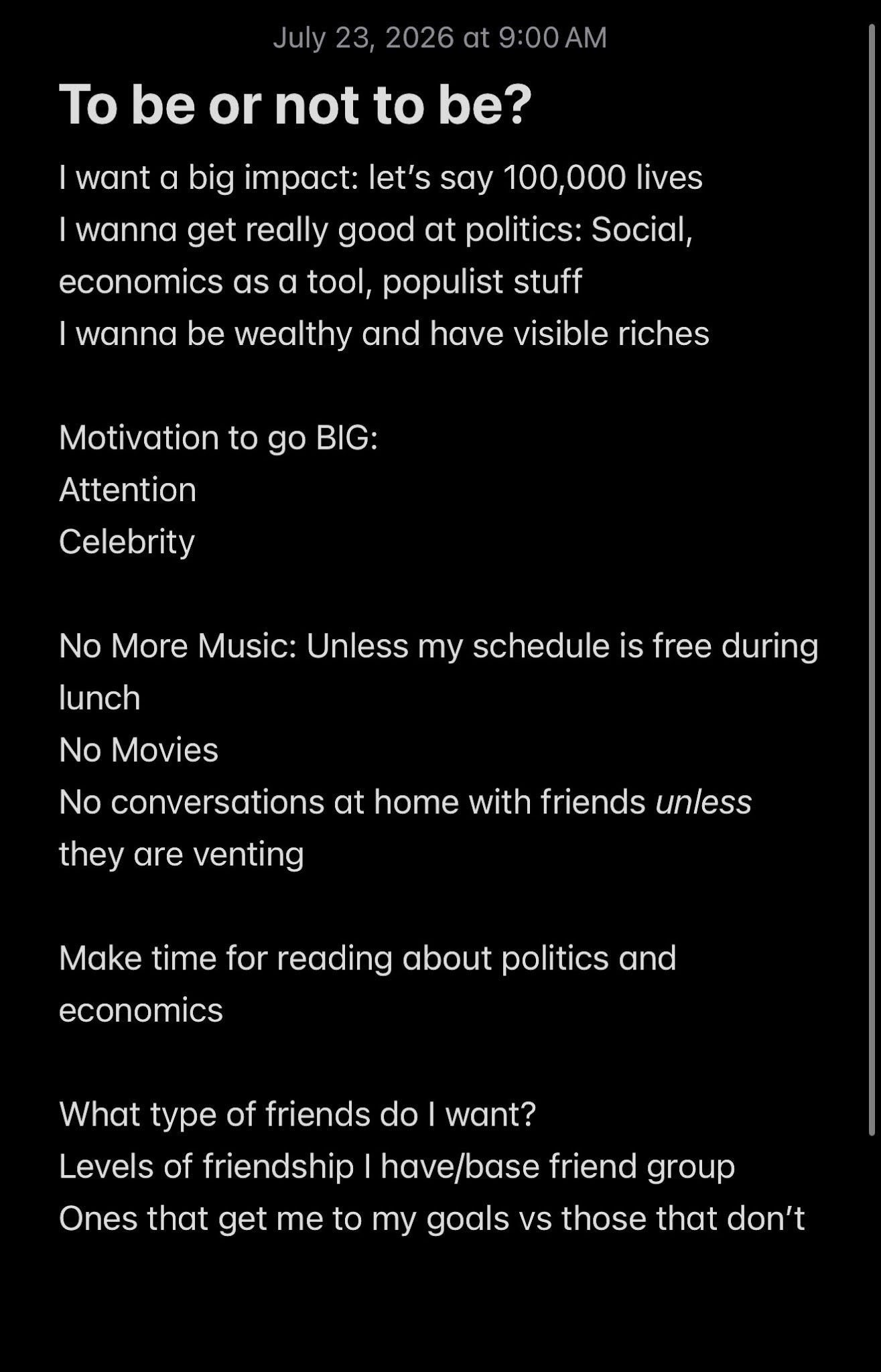
This wasn’t much of a departure from my old ideas of success, it just emphasizes the why more. An impact is something I want to keep growing for its sake, regardless of how many views a single essay or episode gets. Quality and volume are the only inputs I can obsess over without going mad because they are in my control.
As I’m writing this, I’m still asking myself how I see success. What will happen when I’m back at school with the same homeworks, subjects, and tests? Sure, not caring as much came from school’s lack of utility but not being in the building also helped. Then there are my friends. The girl with the nonprofit worked on it all of last year while having the same homework as me. Sometimes it feels like truancy to not care about going AP everything and balancing grades when people like her can!
I remember one morning, after showering, I stopped and asked myself “At the end of my life, would I prefer to have won a Nobel Peace Prize or more attention from others?” I have reasons — however superficial — for being unable to answer this, but it goes to show that nothing is resolved yet.
But wouldn’t it be lame if they were?
We question and wonder things because we hate uncertainty. And however you feel about it, this takes roughly a lifetime to finish. So to go on saying you’re certain about what you think is a well-lived, successful life ignores maturity, big life events, and the fact you may have inherited this false positive from others.
Because I don’t think anyone can feel certain until they can’t ask questions anymore. So stop trying to “know already” what you think of success — you will on your deathbed, which means you’re already winning.
If you related to feeling “behind” and “broken” in this piece, consider reading…


I've spent the past few years in the same boat. I would study non stop for hours a day because I just wanted to be the best at something, and I was already good at school. I think what happened to both of us stems from a lack of self confidence and identity. We don't need to be anybody to be successful. In my opinion, our success should come from how we improve ourselves and others, even if it's just your family.
I think we are taught that being successful means certain things (getting the best grades, making a lot of money, having a specific career path, achieving a level of fame) and we often don’t stop to question whether that’s actually the case for us. And that can lead to feeling like we are never doing enough and have to push ourselves further, because once you achieve one milestone, the goalpost moves forward.
But I think that we need to reframe how we view success and start asking ourselves how we actually just want to live our lives & spend our time on a daily basis. I think doing a hobby regularly for your own enjoyment is more of a success than pushing yourself to do it to be the best at it, for example, because in the first case you get to have fun day to day and actually focus on the things you like. :)
Thank you for the piece!