
The Procrastination Dilemma
On how a meaningful life is hidden in the way we procrastinate...

How many conversations are happening right now that are changing perspectives? I imagine a stream of people who — after speaking with a mentor, teacher, pastor, or parent — feel like they have entered a room with a disappearing door. Soon, a fervor takes over that asks them “well, are there any more views holding me back?” Sadly, few ever go further when the conversation that could bring about change seems daunting again.
My version of this happened over FaceTime. My friend and I wanted to practice our Spanish but quickly switched to English when we didn’t have the words to describe our futures and ambitions.
I wanted advice on how I could balance my blog with school and dating; these pressures would make my tendency to procrastinate much worse. But it wasn’t her advice about “returning to the task without shame” that struck me. Instead it was when she joked “Ethan, not many people listen to podcasts when they procrastinate.”
I ignored her joke at first as I simply wanted advice on how to stop procrastinating. I still remember how it felt balancing good grades, making music, and talking with different social groups last year. Some days, I’d let my fatigue or boredom get the better of me and I’d either scroll or watch Youtube videos. This always meant waking up early the next morning and scrambling to finish whatever homework I had left.
As days turned into weeks of going to bed late and no longer having the time to eat breakfast, I grew sick of my self-abandon. So I took to journaling and asking ChatGPT what it was about YouTube and Reddit that made weeks of makeup work a good deal. I’d gotten to where a random thought or being a bit hungry could send me away from my work…
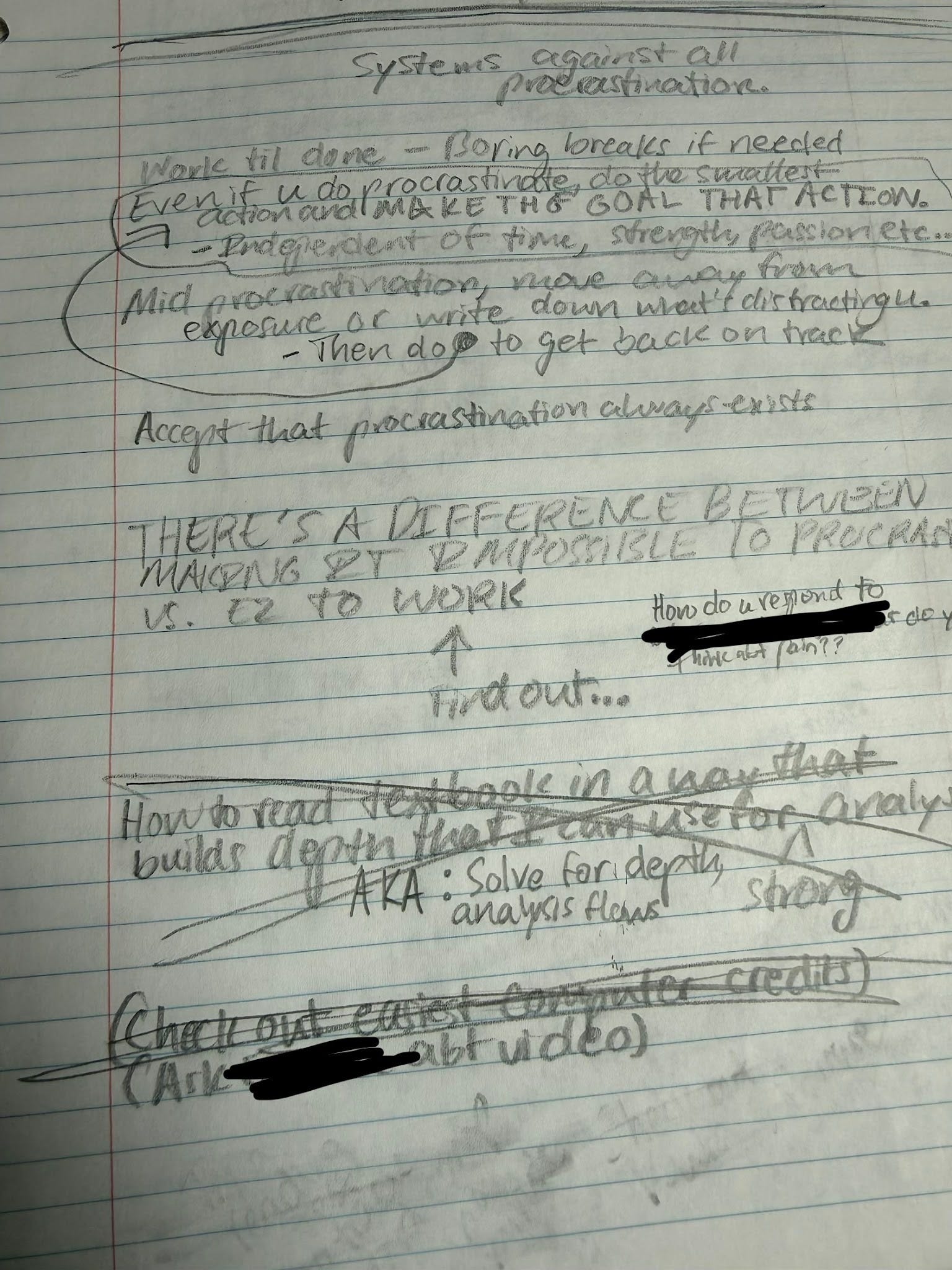
The advice I received from ChatGPT always sounded straight out of Atomic Habits: shrink the task, say you’ll do it for “two minutes,” link your actions to your identity and not motivation. And don’t get me wrong, this was all helpful but…
Giving up procrastination would mean losing the day I called a friend I’d recently made for three hours to discuss politics and her band. I wouldn’t have felt the Sun’s afternoon gaze trace my body as I lay in bed playing music that I knew, a year later, would remind me of that conversation.
It would also mean losing those nights I spent crying and jamming out to my Liked Songs playlist. I couldn’t let my memory of the eras in those songs prune, lest 6th grade enter the same blur as 1st.
I didn’t want to study when weekends had their name for a reason and the extra time could mean ranting to friends, scrolling the Drake subreddit, or reflecting on how the high school movies were right on this being a time of angst, music, and thrill.
So I didn’t give up procrastinating. I watched videos, spoke with friends, and listened to music despite all the shame and work it left me with.
But for whatever reason, I didn’t regret any day of this.
My situation isn’t a success vs. mediocrity dilemma. It’s about separating two ways of living — work vs. fun experiences — that, in my case, need each other. I can’t go and say “alright, no more friends or relationships, I need to write” and expect to rival my essays about body image issues or liking people I shouldn’t have. The work has always been the output of living crazily, not the input.
In fact, I wouldn’t be so passionate about writing this piece if it weren’t for watching The Purge then listening to a podcast earlier.
Ultimately, this is why I sought the advice of my friend. With school work, blogging, and filming the podcast, the only way I can remain consistent is to avoid clubs, sports, and dating. All the things that inspire my writing…
This is the root of the Procrastination Dilemma.
Since noticing this dilemma, I’ve entertained the thought that procrastination is how we stay human. I mean, the two most potent beings — gods and robots — are so unhuman because they can balance maximum power with no breaks. I wouldn’t feel very “human” if I could commit to all tasks with this level of intensity, so no wonder that’s impossible.
The gap between having that ability and being normal is filled with experiences, the sort that color our lives in a way that I think speaks to your humanity.
Recall our modern forms of procrastination, all of which promote useless abandon: excessive video games, inappropriate sites, scrolling, etc. Using them to procrastinate isn’t just time away from work but a break from your mind. This is the other end of being “unhuman:” numbing yourself and being powerless against TikTok or Shorts.
Real leisure produces something: a conversation, a mood, a song… It’s how we used to procrastinate, whether through art, writing, spending time with friends, your spouse, thinking alone, etc.
So maybe there’s a reason why you look at the clock at 2:30am and can’t believe yourself. Again? Maybe procrastination is one of the hardest impulses to control because you’ve been misreading a prescheduled reminder from life to assess who you are underneath the smoke of your work and goals for a problem. So imagine if all you did in that time was watch videos and play games? I think that speaks to how disconnected you are from yourself outside of your ambitions.
For me, all of my procrastination was spent in some state of reflection. I listened to the Diary of a CEO, I called friends, and I thought of quotes. These all take time — so nothing short form — and genuinely add to the writing I do. So it wasn’t just shame putting me to work the next morning but also the idea I got from Bartlett or from last night’s thinking session.
This is why, even as an ambitious person, I find it hard to regret those nights.
So I encourage others to look hard at what they do while procrastinating. You often hear that an idle mind is the devil’s workshop, but God could be there depending on what’s being manufactured: is it a conversation, an idea, or just swipes? Procrastination is unprompted for a reason: it’s meant to reveal who you are by bringing you out of the daily grind. Through it, I’ve come to realize that I’m someone who’s very reflective and curious, so if you find yourself off work a lot, take it as an opportunity to find what brings meaning to your life.
What makes you feel just a bit more human?
For deeply feeling people:


This resonated. The line about work being the output of living, not the input, is a good way to put words to something I’ve felt but never had language for. And the distinction you draw « leisure that produces something vs. leisure that just numbs you » feels like a more useful question than “did I procrastinate today.” Appreciate you writing this.
the gods and robots idea is the best thing in here and i have not seen anyone make that argument before
The two most powerful kinds of being we can imagine are inhuman for the same reason, they run at full output with no breaks. So the inability to do that stops being a defect and turns into the actual marker of being a person. That is a properly original move and it does more philosophical work than most essays on this subject manage.
Then you follow it with the distinction that makes it usable. Procrastination that produces something, a conversation, a mood, a song, a thought you can use, against procrastination that just switches your mind off. Same hours, opposite substance. Everyone can feel that difference and almost nobody has language for it, and now they do.
"The work has always been the output of living crazily, not the input" is the sentence i would put on a wall. You worked out at seventeen what plenty of people never get to at all, which is that you have to live first and the writing comes out of that.
And you refuse to resolve the dilemma. You say plainly that staying consistent would mean cutting clubs, sport and dating, which are the exact things feeding the writing, and then you leave it standing there unsolved. That takes more confidence than tying a bow on it would have.
one thought, and it is only about the opening. the first paragraph, the stream of people and the room with the disappearing door, kept me at arm's length. i read it twice and still was not certain what i was looking at. and then paragraph two is sitting right there, you and your friend on FaceTime practising Spanish and switching to English because neither of you had the words to describe your futures. that is a real scene with real people in it, and it is quietly a metaphor for the entire essay, running out of language exactly where the important thing begins. i would open on that and let the abstract material arrive later, once the reader is already in the room with you
strong piece and the closing question is the right one to end on. thank you for writing it, i will be back for the next